A Deep Dive into Artificial Intelligence with 7-8 Students
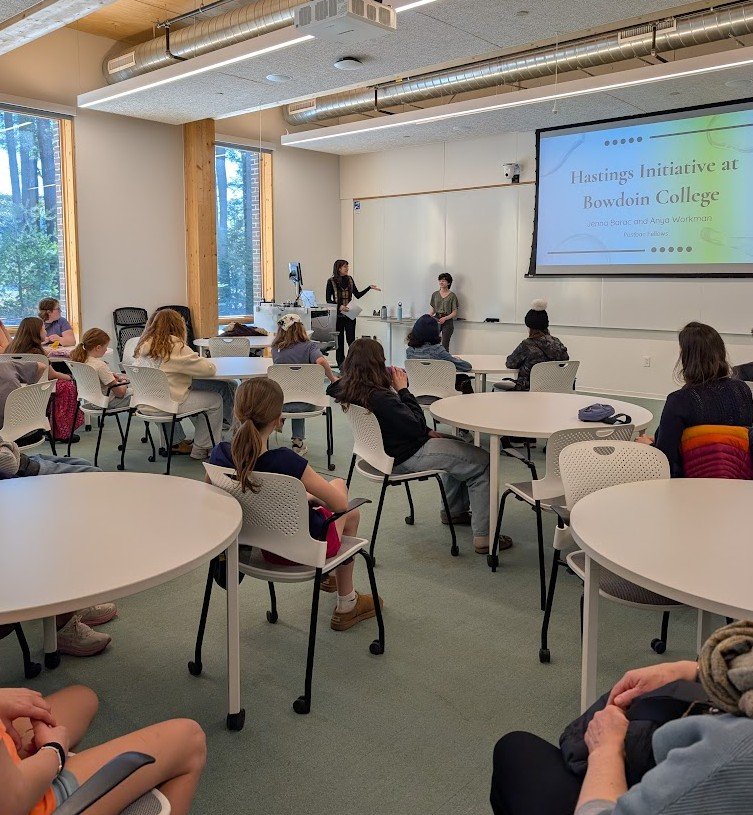
Pictured above: Seventh and eighth-grade students visit to Bowdoin College's Hastings Initiative for AI and Humanity.
by Brooke Burkett, Development Director
Recently, Nicole Favreau, 7-8 science teacher, handed out a science test that had been produced solely through AI. She shared with students that the test was created this way without any edits. Students quickly realized that the test was both confusing and easy. The multiple choice answers were quickly spotted and directly across from the answer, while other questions didn’t make sense and didn’t follow what students had been learning about.
This prompted a lively classroom discussion around the use of AI as a tool and its limitations. “Learning is not about showing up with the right answer quickly,” shared Nicole.
Seventh and eighth-grade students have been diving into the world of Artificial Intelligence. Their recent unit began with defining “What is AI?” and then studying how machines learn and the societal impacts of artificial intelligence.
One student described this as: “Humans create data sets. Data sets inform the algorithms, and then those algorithms make predictions. We have to make sure that we help get good data so that the machines make good predictions.”
Seventh and eighth-grade students learned to make basic video games and experimented with coding. Nicole pulled lessons from MIT’s recent AI curriculum to learn through real-life examples. One example was the science of facial and object recognition: “How can you tell what is real?”
Students used programs like Google Quick Draw to understand how data sets that inform algorithms are created. The unit wrapped up as students co-created recommendations around a policy for the use of AI in their middle school classes.
"As part of a second-semester unit, I joined seventh and eighth-grade students for a discussion of their proposed AI use guidelines. Students had spent time thinking together about the ways that AI could come up in their 7-8 class. I was struck by the ways adults have been talking about the hopes and concerns around AI, and how these students in conversation were already thinking about the importance of staying concious and transparent about their own learning," shared Sara Primo, Head of School.
Their unit wrapped up with a trip to Bowdoin College’s Hastings Initiative for AI and Humanity at the beginning of March.
During the visit to Bowdoin College, students shared their recent individual project studies, including:
AI’s impact on medicine
How AI is emerging in video games
AI’s impact on the job force in entry-level jobs
Then, students learned about some of the recent research that Bowdoin students are engaging in around poverty prediction models in São Paulo, Brazil.
Students left thinking about the question: How do we use generative AI models ethically?