Connecting Inquiry, Reflection, and Action to Social and Environmental Justice
At Friends School of Portland, engaging with issues of social and environmental justice is at the heart of our work as a Quaker School founded on the values of simplicity, peace, integrity, community, equality, and stewardship. If we are to engage with stewardship, we can’t leave aside issues of climate justice. If we are serious about centering equality, we must also engage with inequality embedded in our communities and systems. To think about peace requires understanding conflict. Threaded through the curriculum, rituals and routines of FSP are opportunities for students to use the Inquiry-Reflection-Action lens to engage with issues of social and environmental justice.
Most units of FSP include a social or environmental justice component:
This year, seventh and eighth-grade students engaged in a hands-on science unit using the case study of chemical batteries to teach the science of chemical reactions. After the students had been introduced to the science, 7-8 teachers Nicole and Pete took the time to teach an interdisciplinary follow-up to situate emerging battery technology in the context of environmental and social justice implications. Below is an excerpt from the weekly newsletter sent home to parents/caregivers:
“In science, we followed up last week’s lesson on chemical batteries by thinking about the true cost of lithium-ion batteries both for the environment and on human rights. We followed the story of lithium mining to the only mine in the US in Nevada (there are 70 new mine proposals in the USA) to hear about the heavy usage of water this extraction requires. We then travelled to the Democratic Republic of the Congo to learn about the dangerous mining techniques used to extract cobalt ore from the soil, as well as the toxic health effects and impacts it has had on the environment.”
Similarly, in the context of choosing a national park to study, third and fourth-grade students used the lens of the Native American Land Back movement to ask questions about the history of the parklands and the Native American peoples whose unceded territories comprise the current national parks.
Community gatherings also offer opportunities for connection to social and environmental justice themes. In January and February, an assembly series that focused on learning about Quakers of Inspiration was kicked off with a visit from Portland Friends Meeting member, Rob Levin, who explained to students why he chose to protest the ICE activity in Maine even though it meant being arrested. In March, as disinformation spread in national news around dyslexia and learning disabilities, alum Max Sears spoke during a Wednesday Community Meeting. He talked about his experience as a student with dyslexia, both in middle school and high school. He answered questions from students about his experience, and he explained to students that having dyslexia has been a gift, because he learned how to work really hard to accomplish a goal (learning to read), and he has been able to apply that to other goals in his life.
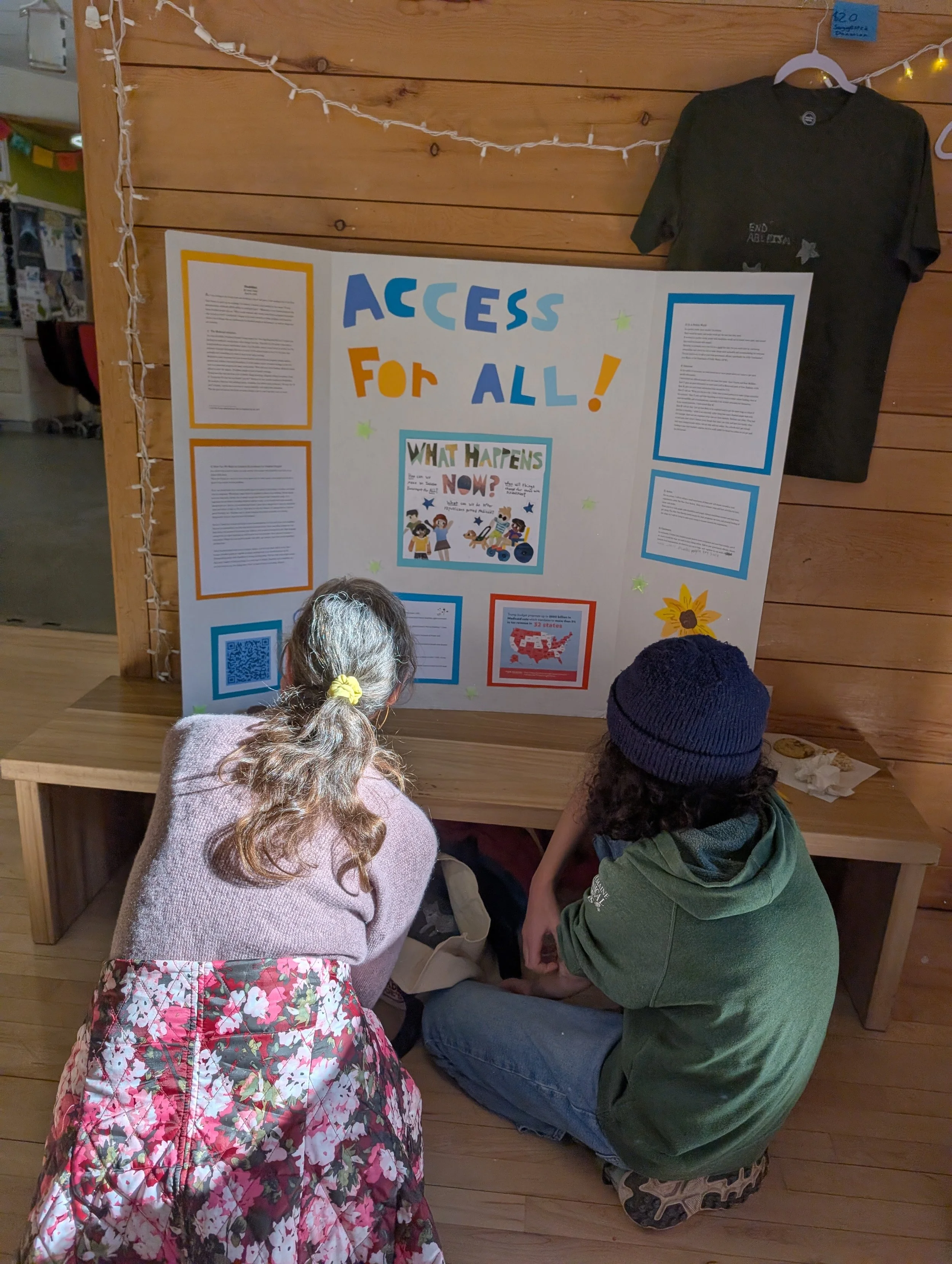
Engaging with issues of social and environmental justice is a core principle of the program at FSP at all grade levels. For our students, this journey begins with deep work in the early childhood years on how to manage conflict and how to build classroom communities where everyone belongs. It culminates with seventh and eighth-grade Year End Projects (YEPs), in which students become experts in an environmental or social justice issue and design and participate in an action around that issue, and then in their end-of-year trips, which have an environmental justice focus in seventh-grade, and a social justice focus in eighth-grade.