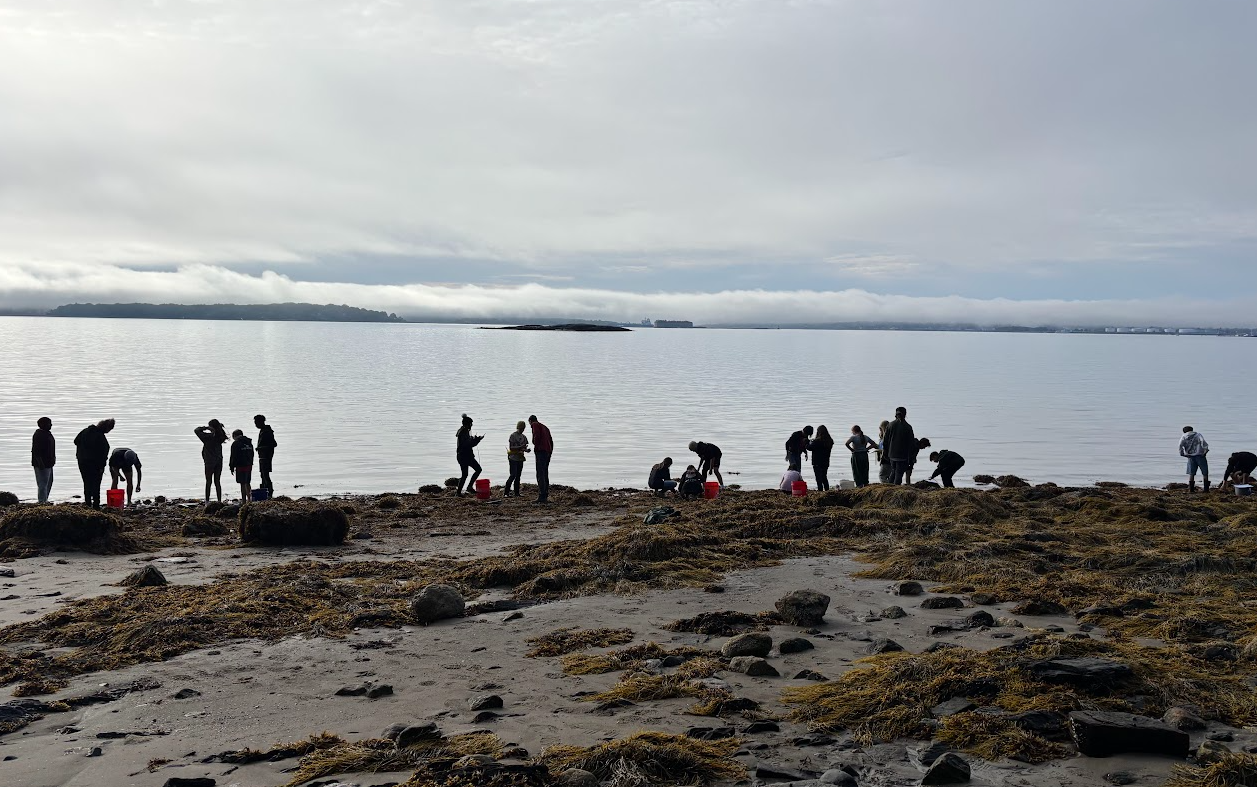
Pictured above: Seventh- and eighth-grade students working together in the field collecting data on crabs living in the intertidal zone. Students began by asking questions like: "How do different species of crabs interact?" "Why are there so many different intertidal crabs in Maine?" After three weeks of fieldwork in different locations, students are now charting species found by substrate, sex, and species.
by Jen Willis, Interim Director of Studies + Student Support
For most of my years as a student, I loved answers. The certainty, the accomplishment, the satisfaction. But now, entering my thirteenth year as an independent school administrator, I love questions. The reflection, the spaciousness, the discovery. Joining Friends School of Portland as the Interim Director of Studies and Student Support this year, I have been energized by the opportunity to dive deeply into Quaker Education and have felt particularly inspired by the use of queries in guiding the inquiry, reflection, and action process. Preparing for our recent Family Curriculum Night prompted me to reflect upon four queries that relate to our focus testimony this year: Simplicity.
In what ways is it hard to practice simplicity?
One facet of simplicity, at least in my mind, is being present. Simplicity - again, for me - is not always about doing less or slowing down, and it doesn't even necessarily mean taking the most direct path. But being present, yes! I have seen this in our classrooms over the last few weeks: teachers staying present with our students - with our children - in quiet moments and in moments of uncertainty and stress.
It can be hard to practice simplicity - to stay present - in moments of uncertainty, in moments of stress, in moments of growth. There is so much newness throughout the year, but especially in these early weeks and months.
It can be hard to practice simplicity and stay in the moment when worry jumps ahead and starts asking questions...often “what if” questions…that ultimately serve to pull us out of the now, out of the present. But it is in the here and now that children learn the “how”...how to be part of a group, how to try a different strategy when the problem calls for it, how to ask for help.
It can be hard to practice simplicity when there is so much pressure, from so many sides, to raise “happy” children, and children who only develop in a linear, typical way. It is hard to practice simplicity when the present feels messy. But learning isn’t linear. It isn’t time-bound. And it can be messy.
How is less sometimes more? offers a paradoxical lens through which we can extend this exploration of being present for our students and living in the messiness of growth.
Last week, faculty members offered reflections on what they wanted parents and families to know about their classrooms and our school. What I heard from them was validating, affirming, and inspiring. One teacher shared that our focus is on knowing and being known, using joy and play to create practices and habits that allow students to take risks and make mistakes. Another teacher spoke about how teachers help students know themselves and others, and learn to advocate for what they need, understanding that different people may need different things. This work, which is deeply connected to establishing a sense of community, connection, and belonging - all incredibly important to learning - often happens in small, simple ways. It happens through eye contact and a handshake. It happens through quiet conversations and playful interactions. It happens in nature, in group work, and through the creative process.
Simplicity, for me in this context of teaching and learning, takes shape as clarity of purpose and intentionality. And sometimes it’s hard, and sometimes less is more.
What does simplicity mean to me? I extended to ask, What does simplicity mean to me in the context of learning?
To me, simplicity in the classroom does not mean covering less ground, nor does it mean slowing down or even taking the most direct path. Instead, simplicity allows us to offer our focused attention to that which is most important and to let go of what is not serving those values and goals.
Having spent the last twelve years in the high school setting, shepherding ninth-grade students through the academic transition to high school, I have answered the same question about readiness dozens - maybe hundreds- of times. It’s easy to get caught up in thinking about what’s next, how to get ahead. I worked with students coming from all over the United States and from dozens of countries around the world. Parents pushed to have their students ready for geometry…sometimes Algebra II…even Precalculus! I worked with students entering advanced levels of Spanish and French, and students who were in the process of learning a third or even a fourth language. I saw the pressure.
It is fantastic that math students at FSP finish having completed Algebra I and are ready for Geometry. It is fantastic that our students are prepared to enter a high school Spanish II class as ninth-grade students. That happens here, and I see the value. Yet these are not the signals I have come to understand and appreciate as genuine advantages or the meaningful predictors of success that demand our focused attention.
Instead, the simple truth is that students who are willing and able to connect with adults, students who are willing to take healthy risks and try new things, and students who understand who they are as learners…those are the skills and characteristics that predict holistic success.
How am I deliberate in clearing the way for what is important and what matters?
Recently, one middle school teacher shared that the chance to be in joyful learning together is a gift, and that he and his colleagues never take their work with your children for granted. Another, she spoke about how learning is not linear in nature, highlighting how students will not all be at the same point at the same time, and how she and her colleagues rely on faith, patience, and practice to support student development. When I was having this conversation, our 5-6 teaching team was off campus with students at the Common Ground Fair, so while they did not offer explicit responses in the moment, their actions clearly point to what I believe are familiar themes here at FSP: relationships, engagement with the world around us, and joyful learning.
Our middle school program is unique in the undeniable intentionality that exists at its very foundation, clearing the way for what is important and what matters. The program, schedule, and structure were all designed with this specific audience in mind, and with a recognition of their developmental needs. Preparation for high school does not mean replicating a high school environment; it means promoting the academic, social, emotional, and behavioral skills, and confidence that will allow students to maintain and accelerate their growth and learning for years to come.
For me, simplicity takes shape as clarity of purpose and intentionality. I have seen how deliberate Friends School’s faculty is in clearing the way for this important work, and I look forward to the school year ahead.