
Quaker Terms: Thinking Deeply About the Practice of Seasoning
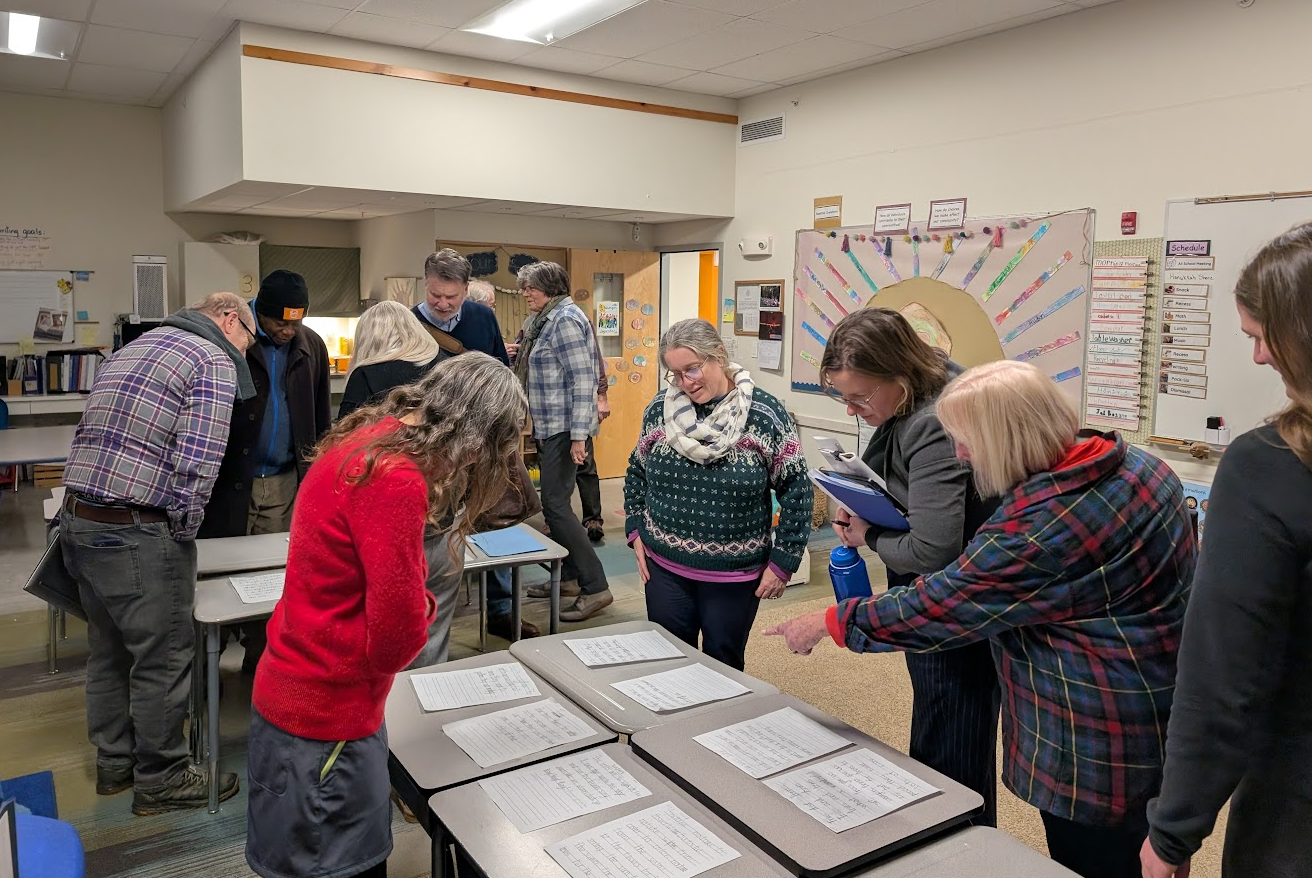
Pictured: Before their December retreat, Friends School of Portland Board members had a chance to read student poetry written as part of their "Holiday for the Birds."
Over the last two years, Friends School of Portland’s Quaker Life Committee compiled a Faith and Practice Booklet. We had lively discussions around what terms should be included in the glossary section. We made sure to include terms that we use regularly, but knew that we would need to leave out some “Quaker lingo.” One of our Quaker Life Committee members had seen that San Francisco Friends School frequently publishes a Quaker Glossary, a reflection on a Quaker term. We wondered if we might be able to attempt something similar.
At Friends School of Portland, you might catch Director of Studies, Nell, saying, “Let’s marinate on this topic for longer.” Board member, Quaker Life Committee member, and Portland Friends Meeting member, Kirk Read, took time to write down and share his thoughts on the related Quaker term: seasoning.
Here are a few words about seasoning from Kirk:
The practice of seasoning in the Quaker faith tradition is central to our seeking of a way forward with important decisions. As an overarching idea in Quakerism, seasoning, as its name implies, invites us to contemplate decisions fully, with all perspectives and contingencies in mind. Seasoned dishes combine a variety of elements and flavors that compose a satisfying meal; seasoned wood has been allowed to weather and mature, distilling its potential for construction or fire-making; seasoned colleagues bring a wealth of experience from a diversity of perspectives and histories; seasoned decisions allow us to move forward having taken the time to listen deeply, both to the issue at hand and to that of the divine in all gathered.
Seasoning implies a slowing down, sometimes a hiatus in our process of discernment. When discussion becomes confused or heated, or dominated by an agenda that seems difficult to respond to, a member of the group may call for a moment of seasoning in real time. This is often a retreat into silent collective consideration. The impulse is to slow down, listen to what has been said, and proceed in the spirit of listening to that of God in all involved and the diversity that implies.
A playful riff on an age-old adage says, "Don't just do something, sit there!" Quakers may be seen as embracing a practice that moves forward at the pace of trust, open to the leadings that arise through multiple, often surprising contributions. As it is for smaller, more everyday decisions, so it is in larger, more impactful initiatives. It may be that one of those gathered proposes suspending consideration of the topic, sensing that opinions and information are still too unformed. The call to season our deliberations is to listen deeply. We strive to hear an emerging, divine resolution and, as William Penn invites, "Let us then try what love will do."